
1.51x
73%
Days to Heal
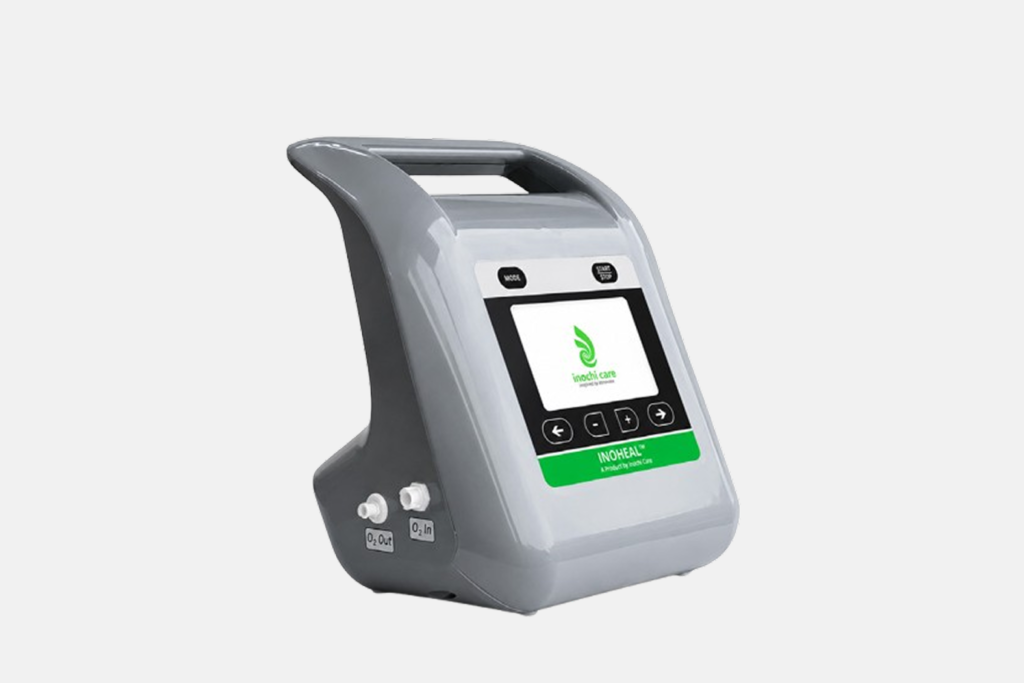
An advanced portable wound healing system designed for complex and non-healing wounds. The device seamlessly combines Negative Pressure Wound Therapy (NPWT) and Topical Oxygen Therapy (TOT) into a single automated workflow without requiring dressing changes or manual intervention.
An advanced portable wound healing system designed for complex and non-healing wounds. The device seamlessly combines Negative Pressure Wound Therapy (NPWT) and Topical Oxygen Therapy (TOT) into a single automated workflow without requiring dressing changes or manual intervention.
Monitors real-time wound-site pressure via integrated sensors with real-time blockage detection.
Delivers regulated, continuous high-concentration oxygen directly to the wound bed during TOT cycles.
Connects seamlessly to hospital central O₂ supply or external gas cylinder with internal precision pressure regulation.
Detects leaks and blockages autonomously using self-clearing air bursts to prevent therapy disruption.
Visual warning of early leakage trends before alarm triggers, preventing dressing collapse.
Diabetic patients developing a foot ulcer in their lifetime
Annual global cost of chronic wound management
Diabetic foot ulcers leading to amputation
Hospital readmission rate for non-healing wounds
| Feature / Metric | Specification Detail |
|---|---|
| Therapy Type | Negative Pressure Wound Therapy (NPWT) + Topical Oxygen Therapy (TOT) |
| Pressure Control | Advanced PID algorithm - maintains stable wound-site pressure |
| Accuracy | ±5% at wound site - NABL certified |
| Battery Backup | Up to 8 hours continuous operation |
| TOT Delivery | 100% O2 at 10 mBar, sensor-regulated; connector for hospital central O2 supply |
| Canister Capacity | 600 ml transparent, spill-proof, unbreakable canister with integrated bacterial filter |
| Interface | Push-button; single-operator design |
Su J, Zhang D, Du J, et al. The Efficacy of Negative Pressure Wound Therapy Combined with Topical Oxygen Therapy in Treating Chronic Refractory Wounds: A Systematic Review and Meta-Analysis. Adv Wound Care 2025.
Results reported in the meta-analysis of NPWT combined with TOT.
Healing rate (RR: 1.51)
Lower infection (RR: 0.27)
Mean difference in time to heal
Reduction in time to skin grafting
Prepare the wound bed
Place the dressing over the wound
Attach the tubing and connectors
Fit the canister and get the unit ready
Choose your therapy on the screen
The proprietary dual-tube architecture is central to regulated NPWT + TOT and autonomous safety management:
Monitors real-time wound-site pressure data via double tube connector having integration with the sensor and real-time blockage detection.
Delivers regulated oxygen to the wound surface during the TOT cycle.
Connects the device to the hospital central supply or external cylinder, with internal pressure regulation.
Detects leaks and blockages autonomously; self-clearing air bursts help reduce therapy interruption without manual intervention.
Provides real-time early warning of leakage trends before full alarm threshold, preventing therapy discontinuation.
| Feature / Metric | Specification Detail |
|---|---|
| Therapy Type | Negative Pressure Wound Therapy (NPWT) + Topical Oxygen Therapy (TOT) |
| Pressure Control | Advanced PID algorithm - maintains stable wound-site pressure |
| Accuracy | ±5% at wound site - NABL certified |
| Battery Backup | Up to 8 hours continuous operation |
| TOT Delivery | 100% O2 at 10 mBar, sensor-regulated; connector for hospital central O2 supply |
| Canister Capacity | 600 ml transparent, spill-proof, unbreakable canister with integrated bacterial filter |
| Interface | Push-button; single-operator design |